
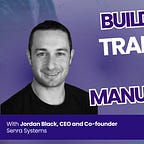

Jordan Black had spent five years on wire harnesses at SpaceX when he flew to a factory in Mexico that builds automotive harnesses at high rate. One every two minutes. He spoke Spanish to the floor lead and asked to get on the line.
He couldn’t build one.
“I should know this,” he told me. “I’ve been through the wringer at SpaceX understanding how wire harnesses get made, and I couldn’t even build a wire harness down there.” His conclusion was that something in the industry was broken if an expert couldn’t walk into a factory and do the work. He compared it to Wi-Fi. Nobody thinks about how to connect when they walk into their house. A technician on a harness line should get the same treatment.
He left SpaceX on a Friday and started Senra the next week.
About Jordan Black
Jordan’s path into manufacturing went through customer service first. He started as a busboy and host, and he liked making someone’s night out go well. Then he fixed roller coasters at the Santa Monica Pier, at 4 AM, on bad coffee. He interned at Ford. At 21 he interviewed at SpaceX with several teams, and they put him on wire harnessing. He says he had no idea what a harness was until he got to the department.
He stayed in it for years as a manufacturing engineer, then became manager of avionics R&D, which covered machining, PCBAs, harnesses, and electromechanical assembly for rockets and satellites. In that role he brought machining and PCBs in house. Harnesses stayed outside. SpaceX sent him to suppliers in the US and abroad, and what he saw scared him: wooden tables, workers without formal training, and no tools or software telling anyone where a wire goes.
About Senra Systems
A wire harness is every wire that carries power and data through a machine. Jordan describes it as an iPhone charger that can be as long as a space shuttle. Without it, nothing turns on. He knows the cost personally. A rat ate through one wire in his Toyota and the car was dead.
Senra builds these harnesses for aircraft, spacecraft, launch vehicles, satellites, and defense systems. It runs on its own software platform, Amp, which ties quoting, engineering, supply chain, and production together. The company opened its second factory in Cypress, California this year, raised a $65 million Series B in July co-led by Lowercarbon Capital and Interlagos, and is already planning a third factory. The problem it solves emerges from the fact that the average harness technician is about 55 and has done this for twenty or thirty years. Demand for rockets, missiles, cars, and reactors keeps going up. The supply of people who can build harnesses keeps going down.
Key Takeaways
1. Find the work your customers can, should, and do outsource.
SpaceX is famous for building everything itself. Why did it outsource about 95% of its harnesses for Falcon and Dragon?
Jordan’s answer was about money and timing. Harnessing is the most labor intensive process in the building, and there is no course or certification that teaches it. The demand curve is also brutal. A new sensor moves a wire, so the whole harness changes. Harnesses are the last thing designed and one of the first things needed. “If I hire 100 technicians and I actually won’t have work for them for three months... you don’t want people twiddling their thumbs.” A machine can sit idle and depreciate. A crew can’t.
A contract manufacturer with five to twenty customers can smooth that curve and that’s the gap that Senra has stepped in to fill.
2. Pick the worst part, and build that first.
Jordan says his go to market was opening his laptop to emails from people begging for harnesses.
Two weeks after he started, he walked around El Segundo with about $200,000 in pre-seed money and told companies he would build their harnesses on his apartment floor. A pizza automation company took the bet. Although Senra lost money on the job, a few months later, as a five person company, his pitch to customers was this: “Give me your worst wire harness that nobody else wants to build that you’re complaining about all the time... I don’t care what the contract size is.” The first Anduril order was about $300.
The worst part on a customer’s list is the one where they have the least to lose by trying you.
3. Know which sale you’re in.
Jordan is honest that the early wins were network wins. The SpaceX tenure is actually pretty short, so its alumni are spread across defense tech, nuclear, and space startups. Shared investors and shared history got him a shot on goal, and being a 20 minute drive away helped too.
But moving into prime deals required a different motion. As Jordan explains, “There is a large team there that needs to know, are you gonna be around for the next 30 years, ‘cause that’s how long their next program’s gonna be.” His network alone couldn’t answer that question, but the early deals helped him build the capacity, processes, and proof points that could.
4. Build capacity before the demand is in the building.
The tipping points for Senra have followed a similar pattern: Senra kept running out of space. They went from his apartment to a 2,500 square foot shop and filled it in about four months, with one bathroom for 20 technicians. Then the next space filled up. Now he is a third of the way into the new factory and thinking about the next one.
Jordan actually sees the slow expansion as a mistake. “This is probably one of the things I shot myself in the foot… where I think we could have scaled faster.” His rule now is: “You have a 0% chance of winning if you have a fully booked factory all the time.” Senra went from hiring four technicians a month to 20, and he expects to double that.
5. Write the recipe before you buy the robot.
The old guard says harnessing will always be 100% manual.
The new crowd says robots will run the factory in twenty years.
Jordan’s view is that you find the biggest bottleneck, fix it, and move to the next one. Often the bottleneck is boring. “Why did this technician take three hours to find a tool in the factory?” Fix that before you buy a robotic arm.
Senra took training from 18 to 24 months of learning on the floor down to four weeks. Two things made that possible: 1) Senra’s own Department of Labor-certified apprenticeship. And 2) its own operating system that tells a technician exactly how each harness gets made. He uses a Cheesecake Factory comparison. Ask a cook to make chicken parmesan with no recipe and you get something close. Hand them the recipe and you get the dish. Training alone won’t fix a spreadsheet or a hand drawn Visio file with “go figure this out” attached.
The same logic is why he thinks Senra will be the one to bring robots in. “If you are having Bob and Judy build something and they’re doing it with all tribal knowledge, good luck trying to get a robot to do that thing.” The data comes from the process, and the process comes first.
For more on Senra: https://senrasystems.us/
Follow Jordan: https://www.linkedin.com/in/jordan-black-138419a1/
Follow Noah: https://www.linkedin.com/in/noahsheinbaum/
Follow Crossing the Valley: www.valleycrossers.com


